

The global financial infrastructure is undergoing a fundamental retooling. While retail speculative traders watch hourly crypto charts, an elite contingent of traditional finance (TradFi) institutions, Wall Street veterans, and primary blockchain innovators are quietly aligning the pipes for a massive capital migration.
At the center of this structural shift sits the XRP Supercycle—a macroeconomic phenomenon driven not by retail hype, but by heavy institutional capital allocation, regulatory alignment, and the rapid tokenization of Real World Assets (RWAs).
From Citi alumni launching XRP-backed structured securities to the XRP Ledger (XRPL) vastly outpacing legacy smart-contract chains in RWA net inflows, the metrics reveal a supply shock building in slow motion. This comprehensive analysis breaks down the hidden mechanics driving the incoming supercycle, examines the structural utility data, and projects what happens when institutional rails open up at scale.
1. The Anatomy of an Institutional Crypto Supercycle
A traditional crypto market cycle is driven by Bitcoin halving events, narrative shifts, and retail speculation. An institutional supercycle, conversely, occurs when a digital asset integrates directly into the operational fabric of multi-trillion-dollar industries.
For XRP, this supercycle rests on a structural foundation: fixed utility demand meeting an absolutely finite supply.
+-------------------------------------------------------------+
|                THE XRP UTILITY & SUPPLY SHOCK               |
+-------------------------------------------------------------+
|                                                             |
|   [Trillion-Dollar RWA]      [Cross-Border Liquidity Flows]  |
|      Tokenization Market         Cross-Chain Infrastructure  |
|               |                               |             |
|               +---------------+---------------+             |
|                               |                             |
|                               v                             |
|                 [ XRP Ledger (XRPL) Engine ]                |
|               - 3-5 Second Finality Time                    |
|               - Minimal Fractions-of-a-Cent Fees             |
|                               |                             |
|                               v                             |
|                 [ Permanent Deflationary Burn ]             |
|             Every transaction permanently consumes          |
|             a piece of the fixed 100 Billion Supply         |
|                               |                             |
|                               v                             |
|                 [ STRUCTURAL PRICE APPRECIATION ]           |
|                                                             |
+-------------------------------------------------------------+
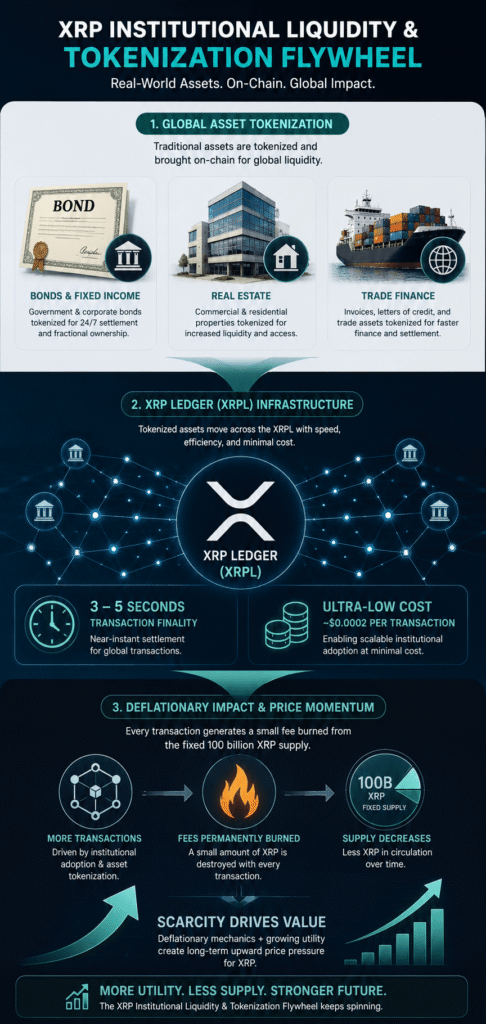
XRP is engineered with a hard supply cap of 100 billion tokens. Unlike fiat currencies that face continuous printing, or proof-of-work protocols with ongoing mining emissions, the total pool of XRP can never increase. In fact, it is structurally deflationary; every single transaction executed on the XRPL destroys a small portion of XRP as a gas fee.
When multi-billion-dollar corporate settlement systems route their volume through this infrastructure, the constant, predictable buying pressure meets a diminishing supply, changing the valuation calculus entirely.
2. Real World Asset (RWA) Flow: XRPL Outpaces Ethereum
For years, Ethereum was considered the undisputed home of decentralized finance (DeFi) and tokenized projects. However, recent network data reveals a monumental shift in where institutional money is actually flowing.
Over a crucial 90-day period, the XRP Ledger registered a massive $1.9 billion net inflow in tokenized real-world assets. During that exact same window, Ethereum experienced a $638 million net outflow in the RWA category. This represents a staggering $2.5 billion capital allocation swing away from high-fee ecosystems straight into the XRPL.
Why TradFi is Redirecting Capital to the XRPL
The capital migration is driven by strict math and operational efficiency:
- Gas Fee Optimization: Tokenizing a large corporate bond, a commercial real estate slice, or a trade finance instrument on Ethereum subjects the issuer to volatile, unpredictable gas fees. A sudden spike in network congestion can eat directly into razor-thin transaction margins. The XRPL maintains transactions costing mere fractions of a cent.
- Settlement Finality: The XRPL delivers deterministic settlement finality within 3 to 5 seconds. In institutional finance, where time-value of money is calculated in milliseconds, waiting minutes for block confirmations is highly inefficient.
- Built-in Compliance and Core Features: Unlike general-purpose blockchains that rely entirely on complex, external smart contracts that are vulnerable to code exploits, the XRPL builds essential tokenization tools—such as its Decentralized Exchange (DEX), escrows, and token issuance parameters—directly into the base layer protocol. This provides an enterprise-grade layer of security that traditional compliance officers require.
3. The Citigroup Matrix: Alumni Infrastructure & Trillion-Dollar Outlook
One of the strongest leading indicators of the XRP supercycle is the structural movement of banking talent and executive reports. Wall Street giants are no longer just observing; their alumni are actively building the on-ramps.
The Citi Alumni Security Inversion
A financial technology startup founded entirely by Citigroup alumni launched dedicated XRP-backed securities. These are Wall Street professionals who spent decades working inside the plumbing of legacy correspondent banking networks. When they left to build institutional digital asset infrastructure, they explicitly chose XRP as their foundational collateral layer rather than general-purpose networks like Solana or Ethereum.
These structured products allow large hedge funds, pension funds, and family offices to gain fully regulated exposure to XRP. Because these securities must be physically collateralized, the issuing entities must buy and securely lock away large amounts of physical XRP, isolating it from the active circulating supply.
The $5.5 Trillion Tokenization Blueprint
This infrastructure alignment matches perfectly with recent projections from major global banks. In its comprehensive Tokenization 2030 banking report, Citi projected that the total market for tokenized securities and digital private assets will reach $5.5 trillion by the year 2030.
When asset managers like Franklin Templeton participate in institutional blockchain forums alongside Ripple executives, they openly admit that a $5.5 trillion figure might actually be an underestimation.
Consider the vast scale of the global financial system:
| Financial Instrument Type | Estimated Global Market Size |
| Global Derivatives Market | $600 Trillion to $1+ Quadrillion |
| Global Real Estate Value | $320+ Trillion |
| Global Debt Markets | $300+ Trillion |
| Domestic & International Stock Markets | $100+ Trillion |
If even 2% of these traditional markets transition onto modern tokenized piping over the next five years, the sheer volume of value requiring settlement will dwarf the current entire valuation of the cryptocurrency asset class.
4. Interoperability Mechanics: Ripple and the OpenUSD Framework
A common misconception is that stablecoins like USDT or USDC will entirely replace the need for volatile bridge assets like XRP. The reality of cross-chain infrastructure proves the exact opposite.
Ripple’s onboarding as a day-one integration partner for the OpenUSD multi-chain stablecoin protocol highlights how this works. OpenUSD is built specifically to address liquidity fragmentation across different blockchain networks at an institutional scale.
   [ Blockchain Network A ]              [ Blockchain Network B ]
     (Stablecoin Layer)                    (Stablecoin Layer)
             \                                     /
              \                                   /
               v                                 v
         +---------------------------------------------+
         |      OpenUSD Interoperability Protocol      |
         +---------------------------------------------+
                               |
                               v
         +---------------------------------------------+
         |     XRPL Core High-Speed Settlement Rail    |
         |  - Eliminates fee drag on high volume       |
         |  - Settles across chains in 3-5 seconds     |
         +---------------------------------------------+
When multi-chain stablecoins migrate across fragmented ecosystems, they require a fast, low-cost, and completely neutral settlement rail to manage the underlying liquidity transfers. Because XRP transactions execute instantly with minimal overhead, the XRPL acts as the central connective tissue. By routing these cross-chain stablecoin flows through the XRPL infrastructure, the protocol creates structural utility demand for the network, independent of daily speculative trading.
5. Whale Accumulation and On-Chain Liquidity Metrics
While market commentators debate short-term price movements, on-chain ledger metrics show that large investors are accumulation assets rapidly.
Data highlights a significant divergence between retail sentiment and whale behavior:
- Accelerated Whale Accumulation: Wallets holding between 1 million and 10 million XRP have significantly accelerated their buying velocity, taking supply off exchanges into cold storage.
- Spike in Wallet Creation: The network recently recorded its highest daily wallet creation count in three months.
- The Lagging Price Phenomenon: Historically, a massive acceleration in wallet creation and utility net inflows serves as a strong leading indicator. Price action typically lags behind structural network expansion before experiencing rapid upward discovery.
From a technical analysis perspective, the key macro trigger remains a decisive, volume-backed reclaim of the $1.20 resistance level. Reclaiming this zone clears a multi-year technical ceiling, signaling that on-chain accumulation has successfully absorbed exchange sell pressure and setting the stage for macro price discovery.
6. Crucial Macro Risks and Counter-Narratives
An expert financial analysis requires assessing the structural hurdles alongside the growth drivers. The path to an institutional supercycle faces several distinct headwinds that investors must monitor:
- Regulatory Implementation Speed: While XRP possesses unique judicial clarity in the United States, the broader legislative framework—such as the passage of the market-wide Clarity Act—moves slowly through government channels. Delays in comprehensive stablecoin and tokenization laws can postpone large-scale deployment by conservative banking institutions.
- Institutional Custom Ledgers: Major banks may choose to pilot their initial tokenization projects on highly permissioned, private iterations of the XRPL or proprietary bank networks rather than immediately routing public volume through the mainnet. While these private ledgers ultimately require public interconnectivity for global settlement, the intermediate phase can slow down the immediate rate of public token burning.
- Liquidity Fragmentation: As various competitive networks vie for RWA dominance, liquidity can become temporarily divided across multiple chains, delaying the network effects that the XRPL stands to capture.
7. Common Pitfalls to Avoid in the Tokenization Era
Investors navigating the shifting digital asset landscape should avoid these widespread market errors:
- Overemphasizing Viral Retail Mentions: Looking for validation from corporate celebrity tweets or speculative internet rumors rather than tracking verifiable on-chain metrics, institutional partnerships, and banking reports.
- Misunderstanding Token Supply Dynamics: Confusing the total minted supply (100 billion) with the actual liquid, circulating supply available on public order books. A significant portion remains locked in secure cryptographic escrows or institutional custody, magnifying the impact of sudden demand spikes.
- Ignoring Fee-Drag Calculations: Assuming institutions will naturally build high-frequency settlement products on networks with volatile gas fees. Always evaluate a protocol’s long-term utility based on its foundational cost stability at high volumes.
8. Frequently Asked Questions (FAQ)
What exactly is an XRP Supercycle?
An XRP Supercycle is a prolonged market phase where the valuation of XRP is driven primarily by structural institutional utility, asset tokenization, and cross-border settlement volume rather than standard retail speculation and Bitcoin market halves.
How does the tokenization of Real World Assets (RWAs) affect the price of XRP?
Every asset tokenized on the XRP Ledger relies on the underlying network infrastructure for creation, transfer, and settlement. Increased transaction volume naturally consumes more network capacity, requiring participants to hold XRP and accelerating the permanent burning of transaction fees from the fixed supply.
Why did Citi alumni choose XRP over alternative networks like Ethereum or Solana?
TradFi professionals prioritize predictable operational costs, rapid settlement finality (3-5 seconds), high security, and structural compliance features built directly into the base ledger layer, avoiding the smart-contract vulnerabilities and unpredictable gas fees found elsewhere.
What is the significance of the $1.20 technical level for XRP?
The $1.20 price zone represents a long-standing macro technical resistance level. Breaking cleanly above this threshold confirms that institutional accumulation has successfully absorbed historical market overhead, paving the way for open price discovery.
Will stablecoins eliminate the practical need for XRP as a settlement bridge?
No. Stablecoins are pegged to individual fiat currencies and remain fragmented across various unique blockchains. XRP operates as a high-speed, completely neutral, cross-chain utility asset that bridges the liquidity gaps between different stablecoins and fiat layers seamlessly.
9. Key Takeaways and Conclusion
Strategic Summary
- Institutional Pivot: The XRPL is securing substantial institutional RWA inflows, outstripping legacy smart-contract chains by billions in net capital allocation.
- Structural Supply Inversion: High-velocity utility demands are landing directly on a fixed, structurally deflationary token supply cap.
- Wall Street On-Ramps: Financial industry veterans are actively constructing regulated, XRP-backed investment instruments ahead of upcoming banking integration waves.
Read More ▶ Ethereum Elliott Wave Update – Key Resistance Levels Ahead
Final Thoughts
The quiet re-engineering of global financial piping points toward a clear realization: traditional finance requires speed, low overhead, and ironclad regulatory clarity. As trillions of dollars in real-world assets prepare to migrate onto modern blockchain networks, the structural design of the XRP Ledger positions it as a leading candidate for enterprise-scale adoption. The shift from a speculative asset to a foundational utility rail is no longer a future theory—it is an observable shift occurring directly on the ledger.
Next Action Step
To properly position yourself for this changing landscape, move past short-term social media hype. Monitor verifiable institutional metrics: track weekly RWA net flows, watch for updates on major banking tokenization frameworks, and closely observe macro volume changes around the critical $1.20 technical resistance line.
10. Digital Asset Resource Matrix
A. Internal Development Frameworks
- The Tokenized Banking Paradigm: Exploring how cross-border correspondent banking networks settle value using distributed ledgers.
- DeFi Infrastructure Analysis: A comprehensive guide to tracking institutional net inflows across public layer-1 protocols.
- Deflationary Mechanics in Enterprise Crypto: How transaction fee burning structures alter long-term asset valuation models.
- Understanding Regulated Cryptographic Escrows: The mechanics of institutional programmatic supply releases.
- The Interoperability Standard: Analyzing the role of neutral bridge assets in a highly fragmented multi-stablecoin environment.
B. Authoritative External Resources
- The International Swaps and Derivatives Association (ISDA): Defacto global standards for tracking derivatives scale and institutional contract structures.
- The Bank for International Settlements (BIS): Key academic research and working papers regarding the future of multi-currency cross-border settlement rails.
- The Federal Reserve Board of Governors Financial Stability Reports: Crucial macroeconomic updates detailing the integration of digital assets with traditional banking ecosystems.
Read More ▶ BITCOIN.. MOST PEOPLE ARE NOT READY FOR THIS
🔥🔥🔥🔥🔥🔥🔥🔥🔥🔥🔥🔥
🔒Securely store, manage, and protect your coins with Trezor hardware wallets, app & backup solutions. 👉 41% discount
⚠ Some of the links above are for affiliates. I may receive a commission for you signing up for the platform. Always read the terms and conditions before signing up for any product, platform or exchange. If you are from a restricted region you may get profits rolled back. DYOR and approach at your own risk.
⚠️ Crypto Warning: Always do your own research before using any exchange or service mentioned in this video. Exchanges carry risk, and leverage trading can amplify losses. Terms and conditions may change — read them carefully. Some platforms may be non-KYC now but could require KYC in the future. You don’t have a profit until your BTC is in cold storage or your funds are in a bank account. Stay informed and invest responsibly.